With these personnel picks, Mr. Obama reveals a bias for competence, experience and continuity. Hence the caterwauls from his left flank.--WSJ Editorial Board
... Mr. Obama famously noted during the primary that it was time to move beyond the Clinton era. Instead, he's dragging that baggage back into the White House living room. The Obama team is combing through the hundreds of thousands of donors to Mr. Clinton's foundation. Those papers surely contain compromising conflicts. There was good reason the Clintons have always refused to make that information public.--Kim Strassel
Friday, November 28, 2008
Quotes of the day


Wednesday, November 26, 2008
A death row pardon two minutes too late
isn't it ironic ... don't you think: Elliott Spitzer, the regulatory arm-twister, getting caught by government regulation.
Graph for the centuries

via Barry Ritholtz. Note the red square to the extreme left; that's 2008!
UPDATE: Another great graph from Barry:

Hail, Barack Obama
Agriculture subsidy Killer:
The new administration is giving me ... hope. Just a glimmer, but in these markets, I'll take it.
As part of his plan to kill government programs "that have outlived their usefulness," the President-elect singled out farm subsidies for the rich.This will both reduce prices of food for Americans, and at the same time increase the plight of farmers in Mexico and other nations.
The new administration is giving me ... hope. Just a glimmer, but in these markets, I'll take it.
Quotes of the day
We can remind ourselves that for all our social discord we yet remain the longest enduring society of free men governing themselves without benefit of kings or dictators. Being so, we are the marvel and the mystery of the world, for that enduring liberty is no less a blessing than the abundance of the earth.--WSJ Annual Thanksgiving Editorial
I find that five minutes of talking to Larry [Summers] is often more valuable than an hour of talking to someone else.--Tim Geithner
Volcker is a very, very smart man. It is probably heresy, but I wonder if the endowments, like steel gonads, needed to crush inflation with 20% short term rates, are the same endowments that make you good at battling collapsing credit markets. The man and the moment have to combine correctly--Churchill was very good at battling Hitler, and very bad at peacetime tasks like running the Bank of England, or post-war Britain.--Megan McArdle
When developing countries get into a financial crisis, the problem must lie with their venal politicians and lack of financial discipline. When it is U.S. that is in trouble, the fault must lie with the system. Of course.--Dani Rodrik
So, to push the parlance of this passage past the point that people can put up with prior to puking, as the penultimate paragraph presages, there is plenty of point to pork-barrel politics when it comes to the passage of programs to prop up our pained pecuniary polity and positively impact its per capita product and probable performance.--KNZN
As excited as Europeans were to see Democratic senator Barack Obama elected president in the U.S., there turned out to be an unexpected cloud around that silver lining. Namely, it's that blacks, and minorities in general, have made far less social progress in Europe than in the United States. Obama's election is just another, and rather striking, example of this.--StrategyPage
Benjamin Graham once wrote that the secret to happiness is learning to live well within your means. Did he mean to “live well” within your means, or to live “well within” your means? I think he intentionally left the sentence ambiguous.--Jason Zweig
Favre has played at least parts of 18 seasons. Roethlisberger has played five. They have the same number of Super Bowl titles. Enough said.--Tony Massarotti
Tuesday, November 25, 2008
Prediction markets triumph over polls and pundits
again in 2008:
We debated the merits of collective wisdom earlier this year, after the bettors in the the Intrade online prediction market wrongly picked Barack Obama to win the New Hampshire primary. The bettors are looking more savvy now that the election’s over and the last undecided state, Missouri, has finally been called for John McCain. Once again, collective wisdom backed by cash has triumphed over conventional wisdom — at least when you compare the Intrade bettors with some of the pundits who get paid to make predictions.Here is my work from the primaries, between Zogby and Intrade predictions. I've even seen it cited in major media outlets....The Intrade bettors expected Mr. Obama to end up with 364 votes in the Electoral College — one less than he actually got. None of the pundits came so close. Alan Abramowitz, a political scientist at Emory, came closest with prediction of 361; all the rest were off by at least 12 votes. Nate Silver, the much-talked-about statistician at FiveThirtyEight.com, underestimated Mr. Obama’s tally by 18 votes. Many of the pundits underestimated Mr. Obama’s total by more than 25 votes, like Chris Matthews, Arianna Huffington, and the strategists Paul Begala, James Carville and Alex Castellanos.
As you can see from these maps comparing Intrade predictions with the results, the Intrade bettors didn’t do as well as in 2004, when they called every state correctly. This time they wrongly called Indiana for Mr. McCain and Missouri for Mr. Obama — mistakes that canceled each other because each state has 11 votes. The Intrade bettors ended up one vote off because Mr. Obama collected one of Nebraska’s five votes.
The Charlie Rangel scandal
gets dirtier and dirtier:
Previous Rangel post here.
Representative Charles B. Rangel has helped raise $11 million for a City College of New York school of public service to be named in his honor. In recent months, as questions have emerged about his fund-raising, he has insisted that he has kept his efforts to attract donors scrupulously separate from his official duties in Congress.It's a good thing Rangel is a Democrat. A Republican would not be surviving the media onslaught. Given his party affiliation, Charlie won't suffer one.But Congressional records and interviews show that Mr. Rangel was instrumental in preserving a lucrative tax loophole that benefited an oil-drilling company last year, while at the same time its chief executive was pledging $1 million to the project, the Charles B. Rangel School of Public Service at C.C.N.Y.
The company, Nabors Industries, was one of four corporations based in the United States that were widely criticized in 2002 and 2003 for opening offices in the Caribbean to reduce their federal tax payments. Mr. Rangel was among dozens of representatives from both parties who bitterly opposed those offshore moves and, in 2004, pushed unsuccessfully for legislation to make the companies pay more tax.
But in 2007, when the United States Senate tried to crack down on the companies, Mr. Rangel, who had recently been sworn in as House Ways and Means chairman, fought to protect them. The tax shelter for the four companies was preserved, saving Nabors an estimated tens of millions of dollars annually and depriving the federal treasury of $1.1 billion in revenues over a decade, according to a Congressional analysis by the nonpartisan Joint Committee on Taxation.
Previous Rangel post here.


Quotes of the day
If they are too big to fail, make them smaller.--George Shultz, on Fannie Mae and Freddie Mac
Not only did trillions — trillions — of dollars get lent to people who won't be able to repay them, but Wall Street at the same time created a market in side bets about whether these people would be able to repay their loans. And that market in side bets is tens of trillions of dollars.--Michael Lewis
[Barack Obama] hasn’t “created or saved” the jobs yet - in fact, he’s not even taken office yet.--Ted Turner
Unless Senate Majority Leader Harry Reid (D-Nev.) and House Speaker Nancy Pelosi (D-Calif.) can whip their caucuses into unity, numerous fault lines will be revealed: Southern Democrats vs. Northern liberals on labor law; California greens vs. Rust Belt Democrats on global warming; socialized medicine adherents vs. go-slow health care reformers; anti-war liberals vs. cautious centrists on national security. And don’t forget the anti-bailout crowd vs. the powerful Michigan Democrats in both chambers when it comes to money for Detroit.--Martin Kady
I just think that is an absolute mistake.--Troy Aikman, on the return of Pacman Jones
Price-to-rent ratios are useful, but somewhat flawed
 They give a general idea about house prices, but there are other important factors (like inventory levels, price to income and credit issues). We are getting closer on prices, but it appears we still have a ways to go.
One thing is pretty certain - as long as inventory levels are elevated, prices will continue to decline. And right now inventory levels of existing homes (especially distressed properties) are near all time highs.
New York in for some lean times
Cyrus Sanati reports on Comptroller Thomas DiNapoli's report:
The downturn in the financial markets could eliminate 225,000 jobs and cost the state $6.5 billion in tax revenue related to the securities industry over the next two years, according to a grim report released Monday by New York State Comptroller Thomas P. DiNapoli.
And these estimates may be on the conservative side. The report acknowledges that things could get far worse if structural changes in the industry wipe out many of those high-paying Wall Street jobs forever.Wall Street accounts for 20 percent of the state’s budget, so any permanent changes to the industry could have a disastrous effect on the state’s ability to provide services.
The state of New York now forecasts a budget gap of $1.5 billion in the current fiscal year. That gap is expected to grow to $12.5 billion in the 2009-2010 fiscal year and then balloon to $17.2 billion in 2011-2012 fiscal year.
Warren Buffett's challenge for future financing
as foreseen by the brilliant Andrew Clavell:
... a put written by BRK without collateralisation is worth less than a fully collateralised put by an amount equal to the notional of the put times the difference between a risk free zero and and a zero valued at BRKs credit spread. With a BRK credit spread of 50bps our $19bn credit-risked put is worth 17.2bn, but with current CDS levels of, say, 400bps the credit-risked put is valued considerably less than $10bn! (1)
It will be interesting therefore to see if BRK choose to mark the present value of the puts discounted at their own credit spread in much the same way as banks have realised mark to market gains on their fixed income liabilities as their credit spreads have blown out. (I doubt they will).
Whoever actually still owns these puts/BRK credit risk (GS is still my favourite) likely hedged some credit risk on BRK at inception. Not enough! As equity markets fell and implied volatilities have risen, their credit exposure to BRK has increased enormously. The put owner has been forced into purchasing a lot more credit cover in a nasty cross gamma effect. No wonder BRK's credit spreads have gone bananas; they will likely remain volatile as there is a short cross gamma hedger out there for the next 20 years.
Moreover, as a result of the credit hedger's scramble for CDS protection, his mark to market on the original option is potentially worth only half the value had he been fully collateralised. Time to boot this into the level 3 asset pool I suspect, even if most of the pricing inputs are observable in the interdealer market. Note however the converse is also true - if the market rallies and volatility subsides, the put owner will be long way too much CDS protection on BRK.
Meanwhile, Warren sits there like a contented actuary. He has the cash, he doesn't have to post collateral (we hope), he's comfortable that in 18 years the market will be 65% higher, and he claims he doesn't care about the mark to market risk. I'm not sure he thought it through completely though: even if he has no collateral issues, the action of the person covering themselves against his risk certainly does, and that person is screwing up Warren's ability to finance himself elsewhere.
Why Citi imploded
Felix Salmon shoots and scores, in his consideration of Robert Rubin, Chuck Prince, Vikram Pandit, Sandy Weill, Jamie Dimon, and John Reed.
My thoughts on Bob Rubin sans Fischer Black.
My thoughts on Bob Rubin sans Fischer Black.
Permanent tax cuts are the best stimulus
says Professor John Taylor.
I begged President-elect Obama to accept this same idea when he won the election. Some Taylor Rule musings here.
I begged President-elect Obama to accept this same idea when he won the election. Some Taylor Rule musings here.
Why Don't We Hang Pirates Anymore?
Great question:
Stephens' has a great close:In March 2006, the U.S. Navy took 11 pirates prisoner, six of whom were injured. Not wanting to set a precedent for trying pirates in U.S. courts, the State Department turned to Kenya to do the job. The injured spent weeks aboard the USS Nassau, enjoying First World medical care.
All this legal exquisiteness stands in contrast to what was once a more robust attitude. Pirates, said Cicero, were hostis humani generis -- enemies of the human race -- to be dealt with accordingly by their captors. Tellingly, Cicero's notion of piracy vanished in the Middle Ages; its recovery traces the recovery of the West itself.
By the 18th century, pirates knew exactly where they stood in relation to the law. A legal dictionary of the day spelled it out: "A piracy attempted on the Ocean, if the Pirates are overcome, the Takers may immediately inflict a Punishment by hanging them up at the Main-yard End; though this is understood where no legal judgment may be obtained."
Severe as the penalty may now seem (albeit necessary, since captured pirates were too dangerous to keep aboard on lengthy sea voyages), it succeeded in mostly eliminating piracy by the late 19th century -- a civilizational achievement no less great than the elimination of smallpox a century later.Today, by contrast, a Navy captain who takes captured pirates aboard his state-of-the-art warship will have a brig in which to keep them securely detained, and instantaneous communications through which he can obtain higher guidance and observe the rule of law.
Piracy, of course, is hardly the only form of barbarism at work today: There are the suicide bombers on Israeli buses, the stonings of Iranian women, and so on. But piracy is certainly the most primordial of them, and our collective inability to deal with it says much about how far we've regressed in the pursuit of what is mistakenly thought of as a more humane policy. A society that erases the memory of how it overcame barbarism in the past inevitably loses sight of the meaning of civilization, and the means of sustaining it.
Nancy Pelosi is killing jobs
Unionized, manufacturing jobs, at that:
In a grim world economy, the news that Canada and Colombia signed a free trade agreement at the Asia-Pacific Economic Cooperation summit in Lima last week is something to celebrate. Unless you are an American farmer or manufacturer....It's what you call a win-win. But not for American exporters who compete with Canadians in Colombia. Because Speaker Nancy Pelosi has blocked a vote in Congress on the U.S.-Colombia Free Trade Agreement, American goods will automatically be more expensive than those from Canada by the amount of the existing tariff. If the United Auto Workers thought their Caterpillar exports were losing global ground before, wait until they compete on this not-so-level playing field.
In agreeing to the deal, Canadian Prime Minister Stephen Harper also showed geopolitical leadership: "By expanding our trading relationship with Colombia, we are not only opening up new opportunities for Canadian businesses in a foreign market, we are also helping one of South America's most historic democracies improve the human rights and security situation in their country."
Mike Mussina retires on top
writes Allen Barra:
At Stanford, where Mr. Mussina earned a degree in economics -- and pitched in two College World Series -- he wrote a thesis on the wisdom of signing a professional baseball contract out of college rather than out of high school. Having mapped out his plan, he proceeded to follow it. After graduating in 1990, he was signed by the Orioles organization and pitched 10 years for Baltimore before choosing to go to the New York Yankees....Last week, he made a choice, one that surprised fans and colleagues alike: After 18 years, and just two average seasons shy of the magic totals of 300 wins and 3,000 strikeouts, Mr. Mussina announced his retirement. Why, many wanted to know, did he hang it up so close to achieving numbers that would guarantee him the Hall of Fame? Did he simply do it his way?
Well, yes and no. As he told reporters last week: "People said to me, 'Make sure you do it for yourself.' But the truth is, every decision you make, there's other factors involved. I have young children . . . I'm not getting any younger, they're not getting any younger, and you can't get that time back. It's just the right time for me."
The announcement, when it came, was made by conference call -- neat, efficient and professional, just like everything else Mike Mussina has done in his career.
In truth, Mr. Mussina had known all season long that he would call it quits; he kept the secret from teammates and even Yankee executives because he did not want his retirement to "become the focal point of the season. It was like the last year of high school. You know it's going to end, and you just enjoy the ride." It's worth noting that Mr. Mussina was very nearly class valedictorian; rumors in his home town of Montoursville, Pa., are that he was just too shy to deliver a commencement speech.
His Yankee teammates were stunned to find out that Mr. Mussina, along with comic Jon Stewart, filmmaker Ken Burns and former President Bill Clinton, was a star of the 2006 documentary on crossword-puzzle enthusiasts, "Wordplay"; he never mentioned it to anyone, and most found out when they saw it on TV.
...Rob Neyer, columnist for ESPN.com and author of "Baseball Legends," feels that "a year ago, there was only one argument against Mussina's Hall of Fame candidacy -- that he had never won 20 games. It wasn't a good argument. After all, he'd won 19 games twice, 18 games three times, and at least 15 games in 11 different seasons. Well, now he's blown that argument away by winning 20 games this past season." Not only did he win 20 games in 2008, but he became the oldest pitcher, at age 39, ever to do it for the first time.
Moose, as Yankees fans referred to him, became the first pitcher to win 20 games in his final season since Sandy Koufax did it in 1966. In fact, Mr. Mussina's career both compares and contrasts interestingly with that of the Dodgers' great Hall of Fame lefty. Mr. Koufax pitched for 12 seasons, averaging just under 14 wins a year, while Mr. Mussina pitched for 18, averaging 15 victories. But Mr. Koufax started at a low and ended with a high -- a 36-40 record his first six seasons and 129-47 the final six. Mr. Mussina was slightly better his first nine, 136-66, than the last nine, 134-87. Yet, for his career, he approached a similar level of greatness as Sandy.
Mike Mussina and Sandy Koufax have one other thing in common -- they both knew enough to quit when they were on top.
The Yankee fans never appreciated Moose, because they didn't perceive him as a winner. Ironically, he got less run support from his teammates than any other starting pitcher during his time here.
Now, they are going to keep Jeter and cut Abreu? I am almost feeling pity.
Monday, November 24, 2008
Presidential pardon precedents
and how Obama-nominee Eric Holder failed to come close to standard:
The precedent against pardons for fugitives was set more than 200 years ago by President John Adams. The charge, brought in 1799, was murder on the high seas against a ship’s captain who was clearly trying to put down a mutiny. But the mutineers made it back to the States, ready to testify against the captain, while his supporters were still at sea. The captain was afraid to return. Asked to approve a nolle prosequi (a notice that prosecution won’t be pursued, a procedure then treated as part of the pardon power), the president consulted his cabinet, which concluded that a trial should come first and a pardon, if justified, after that. Clemency, wrote Secretary of War James McHenry, should be exercised only with “great caution and on the fullest information.”
Mr. Holder never came close to meeting that standard. He had the last word at Justice on clemency petitions and he saw to it that he had the only word. He brokered one of the most unjustifiable pardons that an American president has ever granted.
Tom Maguire foretells not-so-anti-war President Obama
I still think it made little sense for Hillary to exchange her Senator for Life role for a walk-on spot at State but I'll tell you why Obama offered it to her - soon enough he will be pulling the rug out from under the "anti-war" Dems by making clear the already obvious, namely, all his talk and posturing about deadlines and forced troop withdrawals from Iraq is no longer operative. And when he provides this clarification, Hillary at State will be obliged to defend it; Hillary the Senator might have been in a position to cluck-cluck and rally some Dems against him.
Better late
than never:
Consequently, for far too long, we allowed institutional policies regarding race to be shaped more directly by that ethos than by the principles and precepts of the Scriptures. We conformed to the culture rather than provide a clear Christian counterpoint to it.Not a good thing, to be conflated with Klan.
After waiting for over two weeks for his mate to return

from the sea and relieve him of nest duty, this Adelie penguin's hunger helps him make the decision to abandon his egg in search of fish and krill in the sea.
Charlie Rangel is no longer eligible to represent the Bronx
as he has been a resident of Washington, DC for the last 4 years.
Previous post on Rangel's tax evasion here.
Previous post on Rangel's tax evasion here.
Surprise, surprise, surprise
Malia and Sasha will not go to public schools, but instead to an exclusive private one.
Vouchers for the rest of America, please.
Vouchers for the rest of America, please.
Democrats say they want to improve education
but they actually put unions before kids:
Democrats are fervent supporters of public education, and the party genuinely wants to help disadvantaged kids stuck in bad schools. But it resists bold action. It is immobilized. Impotent. The explanation lies in its longstanding alliance with the teachers' unions -- which, with more than three million members, tons of money and legions of activists, are among the most powerful groups in American politics. The Democrats benefit enormously from all this firepower, and they know what they need to do to keep it. They need to stay inside the box.
And they have done just that. Democrats favor educational "change" -- as long as it doesn't affect anyone's job, reallocate resources, or otherwise threaten the occupational interests of the adults running the system. Most changes of real consequence are therefore off the table. The party specializes instead in proposals that involve spending more money and hiring more teachers -- such as reductions in class size, across-the-board raises and huge new programs like universal preschool. These efforts probably have some benefits for kids. But they come at an exorbitant price, both in dollars and opportunities foregone, and purposely ignore the fundamentals that need to be addressed.
What should the Democrats be doing? Above all, they should be guided by a single overarching principle: Do what is best for children. As for specifics, here are a few that deserve priority.
They need to get serious about accountability. The unions want it eviscerated, and many Democrats are eager to sing their tune: denouncing No Child Left Behind, excoriating standardized tests, opposing consequences for poor performance, and demanding more money.
Real accountability is about standing up for children. The adults are supposed to be teaching kids something, and accountability demands hard, objective measures -- through sophisticated testing and information systems -- of how well they are actually doing that. Good performance needs to be rewarded. But poor performance needs to be uprooted: Schools need to be reconstituted, teachers need to be moved out of the classroom, jobs need to be put at risk -- because if they aren't, children continue to be victimized.
Democrats also have to get serious about school choice. The unions oppose it because they don't want one student or one dollar to leave the regular public schools, where their members teach. So the Democrats have been timid and weak in putting choice to productive use -- even though their constituents are the ones trapped in deplorably bad urban schools, whose futures are being ruined, and who are desperate for new educational opportunities.
If children were their sole concern, Democrats would be the champions of school choice. They would help parents put their kids into whatever good schools are out there, including private schools. They would vastly increase the number of charter schools. They would see competition as healthy and necessary for the regular public schools, which should never be allowed to take kids and money for granted.
Quotes of the day
It was particularly striking for the Fed to maintain an accommodative policy after the 2003 tax cut, which gave another boost to the economy. That was a significant error.--Glenn Hubbard
Actually, the employment benefit of infrastructure projects is more likely to go to the illegal immigrants who were laid off from housing construction and who otherwise would be headed back home.--Arnold Kling
Teachers and administrators are essentially rewarded when minority students drop out, so retention efforts are now virtually non-existent. Why retain students that make it impossible to comply with NCLB, is the unspoken question with a no clear answer.--Rebecca Sato
If I were to try to read, much less answer, all the attacks made on me, this shop might as well be closed for any other business. I do the very best I know how—the very best I can; and I mean to keep doing so until the end. If the end brings me out all right, what is said against me won’t amount to anything. If the end brings me out wrong, ten angels swearing I was right will make no difference.--Abraham Lincoln
Imagine there's an elderly widow down the street from you. She has neither the strength to mow her lawn nor enough money to hire someone to do it. Here's my question to you that I'm almost afraid for the answer: Would you support a government mandate that forces one of your neighbors to mow the lady's lawn each week? If he failed to follow the government orders, would you approve of some kind of punishment ranging from house arrest and fines to imprisonment? I'm hoping that the average American would condemn such a government mandate because it would be a form of slavery, the forcible use of one person to serve the purposes of another.--Walter Williams
Bitchery is a fine art and, whether we admit it or not, we are all appreciators of the craft, if not avid collectors and connoisseurs.--Steffen Silvis
Matt Cassel has accomplished something only five other quarterbacks have done since the NFL-AFL merger 38 years ago. Cassel has thrown for 400 yards in back-to-back games, joining Dan Fouts in 1982, Dan Marino in 1984, Phil Simms in 1985 and -- to add some levity to the list -- Billy Volek in 2004.--Tim Graham
John Cassidy's Bernanke biography
I linked to Roger Lowenstein's piece back in January. Cassidy's offering is also quite good:
The eldest of three siblings, Bernanke learned to read in kindergarten and skipped first grade. When he was eleven, he won the state spelling championship and went to Washington to compete in the National Spelling Bee. He made it to the second round, but stumbled on the word “edelweiss,” an Alpine flower featured in “The Sound of Music.” He hadn’t seen the movie, because Dillon didn’t have a movie theatre. Had he spelled the word correctly and won the competition, Bernanke tells friends, he would have appeared on “The Ed Sullivan Show,” which was his dream.
In high school, Bernanke taught himself calculus, submitted eleven entries to a state poetry contest, and played alto saxophone in the marching band. During his junior year, he scored 1590 out of 1600 on his S.A.T.s—the highest score in South Carolina that year—and the state awarded him a trip to Europe. In the fall of 1971, he entered Harvard, where he wrote a prize-winning senior thesis on the economic effects of U.S. energy policy. After graduating, he enrolled at M.I.T., whose Ph.D. program in economics was rated the best in the country. His doctoral thesis was a dense mathematical treatise on the causes of economic fluctuations....“I always thought that Ben would stay in academia,” Mark Gertler, an economist at New York University who has known Bernanke well since 1979, told me. “But two things happened.”In 1996, Bernanke became chairman of the Princeton economics department, a job many professors regard as a dull administrative diversion from their real work. Bernanke, however, embraced the chairmanship, staying on for two three-year terms. Under his stewardship, the department launched new programs and hired leading scholars, among them Paul Krugman, whom Bernanke wooed personally. Bernanke also bridged a long-standing departmental divide between theorists and applied researchers, in part by raising enough money so that the two sides could coexist peaceably, and by engaging in diplomacy. “Ben is very good at respecting minority opinion and giving people the feeling they have been heard in the debate even if they get outvoted,” Alan Blinder said.
The other event that changed Bernanke’s career occurred in the summer of 1999, at the height of the Internet stock boom, when he and Gertler were invited to present a paper at an annual policy conference organized by the Federal Reserve Bank of Kansas City. The topic of the conference—which takes place at a resort in Jackson Hole, Wyoming—was New Challenges for Monetary Policy. Then, as now, there was vigorous debate among economists about whether central banks should raise interest rates to counter speculative bubbles. By increasing the cost of borrowing, the Fed, at least in theory, can restrain speculative activity and prevent the prices of assets such as stocks and real estate from rising excessively.
Bernanke and Gertler argued that the Fed should ignore bubbles and stick to its traditional policy of controlling inflation. If a bubble inflated and burst of its own accord, they said, the Fed could always bring down rates to alleviate damage to the broader economy. To support their case, they presented a series of computer simulations, which appeared to show that a policy of targeting inflation stabilized the economy more effectively than one that targeted bubbles. The presentation got a mixed reception. Henry Kaufman, a well-known Wall Street economist, said that it would be irresponsible for the Fed to ignore rampant speculation. Rudi Dornbusch, an M.I.T. professor (who has since died), pointed out that Bernanke and Gertler had overlooked the possibility that credit could dry up after a bubble burst, and that such a development could have serious effects on the economy. But Greenspan was more supportive. “He didn’t say anything during the session,” Gertler recalled. “But after it was over he walked by and said, as quietly as he could, ‘You know, I agree with you.’ That had us in seventh heaven.”
In December, 1996, Greenspan had warned that investors could fall victim to “irrational exuberance.” Subsequently, though, he had adopted a policy of benign neglect toward the stock market, ignoring warnings that a bubble in technology and Internet stocks had developed. The paper by Bernanke and Gertler provided theoretical support for Greenspan’s stance, and it received a good deal of publicity, something neither of its authors had previously experienced. “Ben was a bit taken aback by the public attention,” Gertler said. “The Economist attacked us viciously.”
In 2002, when the Bush Administration was looking to fill two vacant governorships at the Fed—there are seven in all—Glenn Hubbard, who is the dean of Columbia Business School and who was then the chairman of the White House Council of Economic Advisers, proposed Bernanke. “We needed a strong economist who understood the financial markets, and Ben had expertise in that area,” Hubbard recalled. “He is also an extremely nice person. In terms of getting on with people, he is very affable, and I thought that would help him, too.”
Although the Fed is an independent agency, it is subject to congressional oversight, and Presidents typically appoint people who are sympathetic to their world view. Hubbard knew little about Bernanke’s politics. “I was aware he was an economic conservative, but I didn’t know whether he was a Republican,” Hubbard said. Robert Frank, a liberally inclined economist at Cornell and Bernanke’s co-author on “Principles of Economics,” believed that Bernanke was a Democrat. When the White House announced that it was nominating Bernanke to be a Fed governor, Frank was shocked. “I asked Ben, ‘Why is Bush appointing a Democrat?’ ” Frank told me. “He said, ‘Well, I’m not a Democrat.’ ’’ In writing their book, Frank was impressed not only by Bernanke’s openness to opposing views but also by his wry humor and his lack of ego. “In most situations, he is the smartest guy in the room, but he doesn’t seem too eager to show that,” Frank said.
Obama Effect = Bush Effect

President-elect Obama in his first economic press conference. The 5-handle move down came when he started jawing on how taxes are not fair.
The Folly of Stimulus
by Price Fishback:
One sign that Keynesian budget deficits were not the key to bringing the U.S. out of the Great Depression is what happened after the war. Every Keynesian predicted that the private economy would go into a recession because the large government budget deficits would be eliminated and so many men would be returning from the war jobless. Instead, as government deficits receded, private consumption and investment boomed. Resources were no longer allocated to producing munitions and instead were devoted to production of typical consumer goods and services.
Some people might misconstrue this discussion as saying that the U.S. should not have fought the war. The point here is that World War II was a period of sacrifice when many Americans experienced deprivation on par with what they experienced in the latter stages of the Great Depression. Vast budget deficits were not a stimulus in the normal sense of the word because the U.S. was a command economy devoted to an all-out war effort. William Tecumseh Sherman famously stated, “War is hell.” We should add the phrase, “even when financed by large budget deficits.”

John Paulson may win back-to-back
awards as Best Hedge Fund Trader of the Year. He got it last year, and is up over most of his peers this year, too.
Btw, Paulson is starting to scoop up subprime debt way down here.
Btw, Paulson is starting to scoop up subprime debt way down here.
Friday, November 21, 2008
Joke of the day
Rumor that Goldman Sachs to merge with Citigroup. The new entity will be called Sachs and the Citi.From my favorite broker.
Thursday, November 20, 2008
Quote of the day
I look at this crisis as a mountain of regulatory arbitrage. The brightest financial minds focused on ways to pile risks onto banks without regulators being able to see it.--Arnold Kling
Killjoy economists no doubt will prattle about capitalism. Some nabob will point out that nowhere in the U.S. Constitution is the federal government granted the authority to bail out private companies. Ignore them. We must remain true to our nation's founding principles: no company may be allowed to fail.--Declan McCullagh
This is the same Paul Samuelson who argued, as late as 1989, that the performance of the Soviet economy was a refutation of Hayek's critique of central planning.--Tyler Cowen
Do SATs predict graduation rates more accurately than high school grade-point averages? The short answer is: yes.--Peter D. Salins
Because apparently when primitive societies ruled by authoritarian patriarchies or whatever chop down all their trees and go bye-bye, it’s just the same as when declining sunspot activity changes the weather.--Stephen Green
Now, in 2008, his fourteenth year in the league, the 35-year-old [Kerry Collins] is having his best season ever. This isn't a comeback. We've heard that story before. This is fascinating -- a comeback after a comeback.--Peter Schrager
Policy and parenting
are very similar, according to Russell Roberts:
But reviving an economy is more like parenting. There's no manual. If there were a parenting manual, every hospital would hand one out with every newborn. But there isn't a manual because each kid is different. And parents come to learn that they aren't really in charge. There's too much of the process they can't control. So great parenting isn't about doing whatever it takes. It's an art. It's about a set of principles and knowing which principle to apply in which situation. When to be tough. When to be soft. When to give a kid a do-over.
Even the most skilled parents make mistakes. Not because they don't understand what it takes to be a good parent. Not because they aren't committed to doing the job as well as it can humanly be done. But simply because there's no way of knowing what to do next.
Often what's called for in parenting is the exact opposite of whatever it takes--what's called for is doing nothing.

Newt is right, again
Newt Gingrich is not the most innocent dove in the world. But he and Peter Ferrara are right:
Mr. Obama's tax plan includes creating or expanding nine or more federal income tax credits mostly focused on low- and moderate-income earners, with an estimated cost of $1.3 trillion over 10 years. These tax credits are provided for certain social purposes, such as child care, health care, education, housing and retirement. Buried amid these is Mr. Obama's purported tax cut for the middle class.
For the bottom 40% of income earners, who pay no federal income taxes on net today, these refundable income tax credits will not reduce tax liability but instead result in new checks from the federal government for the targeted social purposes. That's not a tax cut. It's welfare.
These tax credits will do little or nothing to promote economic growth because they do not reduce marginal tax rates -- the rate on the next dollar of income -- to provide powerful, meaningful incentives for productive activities such as investment, entrepreneurship and work. A tax credit is effectively a cash grant that can only affect incentives up to the amount of the grant. Indeed, such tax credits would likely reduce economic growth because the credits are phased out as income rises, and so effectively impose higher marginal tax rates over those income levels.
For a real middle-class tax cut, we should cut the 25% income tax rate that now applies to single workers earning $32,550 to $78,850, and married couples earning $65,100 to $131,450. We should reduce that rate down to the 15% rate paid by workers below these income levels. That would, in effect, establish a flat-rate tax of 15% for close to 90% of American workers.
Marginal tax rates for middle-income families in the 25% tax bracket are too high. Add in effective payroll tax rates of 15% and state income taxes, and these workers are laboring under marginal tax rates of close to 50%. No wonder middle-income wage growth has slowed sharply. Reducing the marginal tax rates for these middle-income earners would lead to income increases for middle-income workers, just as reducing excessive marginal tax rates for higher-income workers did, going all the way back to the Kennedy tax cuts of the 1960s.
This 40% cut in middle-class income tax rates would provide a powerful boost to the economy, greatly expanding incentives for savings, investment and work. This would be much more effective than Mr. Obama's tax plan with it's $1.3 trillion in redistributive tax credits, as well as yet another so-called stimulus package based on another $300 billion or more in increased government spending.
Do Not Resuscitate
Are all institutions like people? Born to die someday? Yes, life well lived, full of achievement and success and touching others in a grandly positive way, it is worth celebrating and honoring.
But nothing in this world lasts forever. Especially to someone who subscribes to natural selection.
Yes, America spends far more in healthcare per capita than other nations. But if we are spending 80-90% of this in the last 6 months of everyone's life, then, in that single way, we should copy what they do in Canada and Europe.
Doesn't the same thing go for a company that provides something that no one wants anymore? Why extend life support by 6 months or more--doesn't it mean denial, extending the mourning process, and a suboptimal allocation of resources? Whether one believes in Heaven or Darwin?
(I have a DNR, and a very sick mom, in case anyone was wondering).
UPDATE: Speaking of healthcare, this strategy will make the mortgage crunch look like the conflict in Grenada, rather than an epic crisis:
You might wonder, what's so bad about Canada? Well, how about 6 weeks waiting for an MRI instead of 6 minutes, 6 months for an organ transplant instead of 6 weeks, and no southern border to cross when a person wants to opt out of waiting or getting 'no' for a procedure or medication?
At least Canada's morbidity statistics will finally be free from the noise that the U.S. care option currently gives them.
But nothing in this world lasts forever. Especially to someone who subscribes to natural selection.
Yes, America spends far more in healthcare per capita than other nations. But if we are spending 80-90% of this in the last 6 months of everyone's life, then, in that single way, we should copy what they do in Canada and Europe.
Doesn't the same thing go for a company that provides something that no one wants anymore? Why extend life support by 6 months or more--doesn't it mean denial, extending the mourning process, and a suboptimal allocation of resources? Whether one believes in Heaven or Darwin?
(I have a DNR, and a very sick mom, in case anyone was wondering).
UPDATE: Speaking of healthcare, this strategy will make the mortgage crunch look like the conflict in Grenada, rather than an epic crisis:
The Obama-Baucus solution to this slow-motion catastrophe is to add tens of millions more people to the federal balance sheet. Because the public option will enjoy taxpayer sponsorship, it will offer generous packages to consumers that no private company could ever afford or justify. And because federal officials will run not only the new plan but also the "market" in which it "competes" with private programs -- like playing both umpire and one of the teams on the field -- they will crowd out private alternatives and gradually assume a health-care monopoly.
Many proponents of plans similar to Mr. Baucus's openly cite this as one of their goals. Eventually, the public option will import Medicare's price controls into the private sector as it tries to manage the inevitable cost overruns. When that doesn't work, Congress will deal with the problem by capping overall spending and rationing care through politics (instead of prices) -- like Canada does today.
You might wonder, what's so bad about Canada? Well, how about 6 weeks waiting for an MRI instead of 6 minutes, 6 months for an organ transplant instead of 6 weeks, and no southern border to cross when a person wants to opt out of waiting or getting 'no' for a procedure or medication?
At least Canada's morbidity statistics will finally be free from the noise that the U.S. care option currently gives them.
Wednesday, November 19, 2008
Quotes of the day
The 'Troubled Asset Relief Program' should now be appropriately titled the 'Bank Assistance Relief Fund'.--Bob Andres
[In 2002] Schiff predicted Nasdaq 500 and Dow 4000 ... Now, had you listened to Peter in 2002, 2003, 2004, 2005, 2006 or even 3/4 of 2007, you lost your shirt. Had you placed bets based on Schiff's market calls, you lost everything you wagered--Todd Sullivan
Television is the first truly democratic culture - the first culture available to everybody and entirely governed by what the people want. The most terrifying thing is what people do want.--Clive Barnes
Joshua Gans wonders about the hyper-Keynesian "solutions"
today, as its not the Fifties anymore.
I think it's a little like medicine in America. Placebos or herbal medicine might be better for the economy, but the voters are expecting ER and Emergency!.
I think it's a little like medicine in America. Placebos or herbal medicine might be better for the economy, but the voters are expecting ER and Emergency!.
My blog has been diagnosed as "scientific"
even though I show so much contempt for "science" here.
Here is the Typealyzer tool, via Greg Mankiw. Even though I am a shadow of Mighty Mankiw, we are both INTJs!
I think that means we are Judging, Thinking, iNtuitive Introverts. As opposed to Perceiving, Feeling, Sensory Extroverts. Frankly, the latter sound a lot more fun.
UPDATE: Apparently, I'm androgynous.
UPDATE: Steve Bainbridge is confused or bemused.
Here is the Typealyzer tool, via Greg Mankiw. Even though I am a shadow of Mighty Mankiw, we are both INTJs!
I think that means we are Judging, Thinking, iNtuitive Introverts. As opposed to Perceiving, Feeling, Sensory Extroverts. Frankly, the latter sound a lot more fun.
UPDATE: Apparently, I'm androgynous.
UPDATE: Steve Bainbridge is confused or bemused.
That's who Kevin Garnett is
Moneyball, Dr. Phil, and Danny Ainge's risky strategy, all rolled into one by Paul Flannery (via Freakonomics):
The Celtics had been bad the previous season, 24-58 bad, but they had hope in the form of the upcoming draft, where two potential franchise players—Greg Oden and Kevin Durant—were waiting. Their plans were tied to the draft lottery, held a month before the actual draft, during which numbers are drawn to determine the order of the first 14 picks. Thanks to their terrible record, the Celtics had the second-best chance of winning the top draft pick. They got the fifth.That disappointment gave way to a bold new strategy. The team would scrap the youth movement that had been under way since the 2005 season and try to pull off not one, but two blockbuster trades. They made the first, for Allen, on the day of the draft. For the second, the Celtics pursued a number of big-name players including Jason Kidd, Shawn Marion, and Gasol, then of Memphis. But all along they were really focused on Garnett. "We had plans A, B, C, and D," says Steve Pagliuca, the team's general partner. "But getting KG was plan A-plus."
The Celtics were taking a big risk, both financially and on the court. To add Garnett and Allen, they had to trade away almost half their roster and take on more than $130 million in contracts for two players in their thirties, i.e., past their prime. Garnett's and Allen's salaries just for last season, combined with Pierce's, totaled $56 million, pushing the Celtics over the salary cap. To complete the roster with veteran free agents, the Celtics had to go into the luxury tax bracket, which demands a dollar-for-dollar penalty. With a final payroll of over $76 million, the Celtics were paying an extra $8.2 million in those luxury taxes, which even in the NBA isn't chump change.
And then, of course, there was no guarantee that having three stars on the same roster would actually work. NBA history is filled with attempts to create superteams, almost all of which have crashed and burned in a dysfunctional mess of conflicting egos and agendas. The most recent example came in 2004, when the Lakers added Gary Payton and Karl Malone to a lineup that already had Shaquille O'Neal and Kobe Bryant. The Hall of Fame foursome were good enough to get to the NBA Finals—whereupon they self-destructed against Billups's Pistons, Payton bitching about his playing time and Shaq and Kobe bitching about each other.
Accordingly, from the beginning, there were doubts in Boston. Two days after the trade, the Globe's Bob Ryan wrote, "That's it? Someone actually thinks this Celtics team will win the East and contend for the championship? Really?" (In fairness, this was before the team had signed James Posey, who would prove to be a critical role player—but then, no one was planning a parade route after he signed, either.)
...NBA superstars are traditionally judged by two criteria, scoring and championships, and the perception is that one feeds directly into the other. Blame it on Michael Jordan. In our mind's eye we will always see Jordan with the ball in his hands at the end of the game—he knows he's taking the shot, his defender knows it, everyone in the freakin' arena knows it, and we all know it's going in. That's greatness defined in the NBA. It's also "not Garnett's game," notes Britt Robson, a Minnesota journalist and longtime Garnett observer. "Some people resent that. They see it as cowardice. They won't say it that straight, but that's what they're implying."
Garnett stands nearly 7 feet tall (he swears that he is 6 foot 11¾), meaning that by all rights he should play center. But he has always steadfastly rejected that categorization. Think about the game's great centers and you think of their go-to moves: Kareem Abdul-Jabbar's skyhook, Hakeem Olajuwon's "Dream Shake." Garnett's moves, by contrast, have no name. His repertoire, heavy on 20-foot jump shots and turnaround fadeaways, is more usual for a guard than a big man. It's also uncannily effective.... by playing outside, Garnett drew attention away from the basket, which for the Celtics meant that Pierce and Rajon Rondo were freed up to attack the rim. It also allowed center Kendrick Perkins to occupy the lane, which left him open for dunks and lay-ups when his defender would inevitably leave him to help cover a slashing Rondo or Pierce. (Perkins made 61 percent of his shots last season.) Garnett is also a deft passer from the high post, and frequently connected with Allen when he came off screens for open three-pointers. Every member of last season's starting five had higher offensive ratings than their career averages, and all but Allen had higher shooting percentages (and he was just 1/100th off his career mark). No one benefited more than Pierce. The Celtics captain set a career high in offensive rating while posting the lowest usage percentage since his second season in the NBA. Put simply, Pierce had less to do, and that meant he did everything better.
The offensive system Garnett enabled the Celtics to run had two primary benefits: It kept players happy, since it got everyone involved, and it made it possible for the team to focus its energies on defense. By the traditional measure—points allowed—the Celtics played the second-best defense in the league last year. But it was even better than that. Hollinger determined that their team defensive rating was almost eight points better than the league average, ranking them the third-best defense in the NBA since the modern box score was implemented in 1974. More impressive, they became a great defensive team after being among the league's worst the previous season. "To put everything together and do it in one year is really amazing," says Kevin Pelton, a writer for the website Basketball Prospectus. Pelton's stats show that the Celtics were the best in the league at defending shooters (the official term, for those taking notes, is "effective field goal percentage defense") and forcing turnovers. They played solid straight-up defense and still were able to gamble for steals. According to Pelton, no team has ever led the league in both categories.
The architect of the Celtics team defense is associate coach Tom Thibodeau, another new addition last season. The scheme relies on constant communication and aggressively switching assignments. In Garnett—who never stops talking, and can shut down any player—he had the ultimate individual weapon to build around. "Kevin sold our team defense," Rivers says. "We give a lot of credit to the coaches, but let's be honest: Without Kevin, it doesn't work."
Garnett was the landslide winner for Defensive Player of the Year, an honor he curiously had never won before. The award was clinched by performances like the one he put in during a game in January, when he found himself matched up with Houston Rocket behemoth Yao Ming, who stands a half-foot taller and outweighs Garnett by 60 pounds. Garnett does not typically guard men of this size, but Perkins and Scot Pollard had both fouled out, and so with just over six minutes left and the Celtics leading by one, he went to work.
Individual defense in the NBA is really about geometry. Yao had been getting the ball about 4 feet from the basket and dropping in bank shots all night. Garnett's job was to change Yao's angle, which he accomplished by pushing him away from his preferred spot before the entry pass arrived. Now 6 feet away from the basket, Yao missed a hook shot. A few possessions later, he had become visibly uncomfortable. He tried an assortment of fakes and pivots, but Garnett held his ground, then swatted away Yao's awkward-looking shot, punctuating the block with a primal scream. With the victory secure, Garnett emerged from a time-out raising his arms slowly skyward, demanding the spotlight, building the crowd into a frenzy.
...
There are three places where the members of a professional basketball team interact. The most obvious is in games, which naturally receive the most scrutiny. The second is in the locker room, and an anthropologist could have a field day studying the complex interpersonal relationships among players, and between players and the press. The third place is behind closed doors, in practice and in meetings, and it is by far the most critical. You can fool the fans and the press, but you can't get anything past NBA players, who are among the world's foremost cynics. "Kevin is all by example," Rivers says. "You can talk about it all day, but if you don't back it up, no one's going to listen to you, and you will get old real quick."
That started during Garnett's introductory press conference, when he refused to have his picture taken without Pierce and Allen in the shot. From that point on, he always waved off questions that even hinted at personal acclaim. After a much-hyped victory over the Phoenix Suns in late March, Pierce gave an emphatic summation of Garnett's impact on the franchise, saying, "He changed the culture around here." Garnett, seated next to Pierce, responded by putting his hand over Pierce's mouth. "We changed it. We."
It continued during the season, as Rivers had to invent ways to shorten practices to prevent Garnett from burning himself out, and in film study, where Garnett immediately owned up to his mistakes—out loud, in front of his teammates. He did it so readily, the coach was taken aback. "In my experience, the star player a lot of times wants to explain their way out of it," Rivers says. "He would look at the tape and say, ‘God, I was awful.' That's leadership."
One day last September, a month before training camp officially opened and a half-hour before an optional practice was scheduled to begin, Garnett was already on the court, working on his shot. After missing three straight, he ran six baseline suicides—two for every miss. This was why the Celtics had blown up their team, and blown the salary cap, but it would be months before their big gamble would be validated. Taking in the scene from above the floor where the Celtics offices are located, Wyc Grousbeck was feeling confident. Turning to friends, he said, "That's who Kevin Garnett is."
Tuesday, November 18, 2008
My muse is dead on November 28
Tradesports says:
Blessed are those who mourn, for they shall be comforted.
I would have never started this blog had it not been for the great leap forward that Tradesports has been for prediction markets, and for my friends in the chat room.IMPORTANT: Tradesports will be ceasing operations on Friday November 28th 2008.
It is with regret that the owners of TradeSports.com have decided to cease operations on Friday November 28th 2008.
Blessed are those who mourn, for they shall be comforted.
Arnold Kling with a great round up of regulatory thoughts
here:
The functional approach to studying financial institutions and regulation begins with the observation that there are six functions of the financial system--a payments system, a pooling mechanism for undertaking large-scale investments, resource transfer across time and space, risk management, information provision for coordinating decisions, and a means of contracting and managing agency problems. Because functions tend to be more stable than institutions, regulations designed around functional specifications are less likely to generate unintended consequences.--Andrew LoThanks to David Warsh for the pointer. Lo has a number of interesting proposals, including the creation of a "risk balance sheet." His point is that accounting statements are historical snapshots, but they don't say much about the susceptibility of the firm's finances to possible future events. I would caution that the Risk Disclosure Problem is not easily solved.James Martin, the guru of information engineering, claimed that within a firm, the data entities are more stable than the business processes, and the business processes are more stable than the organizational structure. So if you're a bank, there will always be entities such as "customer," "account," "interest rate," and so on. The business process may change--you can introduce online banking for example. And you can always do a re-org--you could put transaction processing under "customer relationship management" or under "operations."
...
When I was at Freddie Mac, we tried to use information engineering, but it was too difficult. The result is that we were stuck with a variety of systems that did not talk with one another very well. I suspect that in the real world this is often the case. This suggests another reason to have limited expectations for regulatory reform.
Thirty years after Jonestown
by Dan Flynn (via Jonah Goldberg). It's not just cyanide that ruins the kool-aid; socialism ruins religion, too:
On November 17, 1978, Jim Jones was a hero to American leftists. On November 18, 1978, Jones orchestrated the killings of 918 people and strangely morphed in the eyes of American leftists into an evangelical Christian fanatic. An unfortunately well-worn narrative, playing out contemporaneously in Pol Pot's Cambodia, of socialist dreams ending in ghoulish nightmares, then, conveniently shifted to one about the dangers of organized religion. But as The Nation magazine reported at the time, "The temple was as much a left-wing political crusade as a church. In the course of the 1970s, its social program grew steadily more disaffiliated from what Jim Jones came to regard as 'Fascist America' and drifted rapidly toward outspoken Communist sympathies." So much so that the last will and testament of the Peoples Temple, and its individual members who left notes, bequeathed millions of dollars in assets to the Soviet Union. As Jones expressed to a Soviet diplomat upon upon his visit to Jonestown the month before the smiling suicides took place, "For many years, we have let our sympathies be quite publicly known, that the United States government was not our mother, but that the Soviet Union was our spiritual motherland."
Jim Jones was an evangelical communist who became a minister to infiltrate the church with the gospel according to Marx and Lenin. He was an atheist missionary bringing his message of socialist redemption to the Christian heathen. "I decided, how can I demonstrate my Marxism?," remembered Jones of his days in 1950s Indiana. "The thought was, infiltrate the church." So in the forms of Pentecostal ritual, Jones smuggled socialism into the minds of true believers--who gradually became true believers of a different sort. Unless one counts his drug-induced bouts with self-messianism, Jones didn't believe in God. Get it--a Peoples Temple. He shocked his parishioners, many of whom certainly did believe in God, by dramatically tossing the Bible onto the ground during a sermon. "Nobody's going to come out of the sky!," an excited Jones had once informed his flock. "There's no heaven up there! We'll have to have heaven down here!" Like so many efforts to usher in the millenium before it, Jones's Guyanese road to heaven on earth detoured to a hotter afterlife destination.
The horrific scene in a Guyanese jungle clearing could have been avoided. Thousands of miles north, for years leading up to Jonestown, San Francisco officials and journalists had looked the other way while Jones acted as a law unto himself. So what if he abused children, sodomized a follower, tortured and held temple members at gun point, and defrauded the government and people of welfare and social security checks? He believes in socialism and so do we. That was the ends-justifies-the-means attitude that enabled Jim Jones to commit criminal acts in San Francisco with impunity. The people who should have stopped him instead encouraged him.
Mayor George Moscone, who would be assassinated days after the Jonestown tragedy, appointed Jones to the city's Housing Authority in 1975. Jones quickly became chairman, which proved beneficial to the enlargement of the pastor's flock--and his coffers, as Jones seized welfare checks from new members. One of the Peoples Temple's top officials becoming an assistant district attorney, a man so thoroughly indoctrinated in the cult that he falsely signed an affidavit (ultimately his child's death warrant) disavowing paternity to his own son and ascribed paternity to Jones, similarly enhanced the cult's power base within the city. How, one wonders, did victimized Peoples Temple members feel about going to the law in a city where Jones's henchman was the law?
Going to the Fourth Estate was also a fruitless endeavor, as San Francisco media institutions, such as columnist Herb Caen, were boosters of Jones and his Peoples Temple. When veteran journalist Les Kinsolving penned an eight-part investigative report on Peoples Temple for the San Francisco Examiner in 1972, his editors buckled under pressure from Jones and killed the report halfway through. Kinsolving quipped that the Peoples Temple was the "the best-armed house of God in the land," detailed the kidnapping and possible murder of disgruntled members, exposed Jones's phony faith healing, highlighted Jones's vile school-sanctioned sex talk with children, and directed attention toward the Peoples Temple's massive welfare fraud that funded its operations. "But in the Mendocino County Welfare Dept. there is the key to Prophet Jones' plans to expand the already massive influx of his followers--and have it supported by tax money," Kinsolving wrote more than six years before the tragedy in the Guyanese jungle. "The Examiner has learned that at least five of the disciples of The Ukiah Messiah are employees of this Welfare Department, and are therefore of invaluable assistance in implementing his primary manner of influx: the adoption of large numbers of children of minority races." Unfortunately, four of the series' eight articles were jettisoned after Jones unleashed hundreds of protestors to the San Francisco Examiner, a programmed letter-writing campaign, and a threatened lawsuit against the paper. The Examiner promptly issued a laudatory article on Jones. A few years later, after Jones had moved operations from Ukiah to San Francisco, California, a writer for the San Francisco Chronicle penned an expose on the Peoples Temple. A Chronicle editor sympathetic to Jones spiked that piece, which ultimately made its way to New West magazine and so alarmed Jones that he hastily departed San Francisco for his agricultural experiment in Guyana.
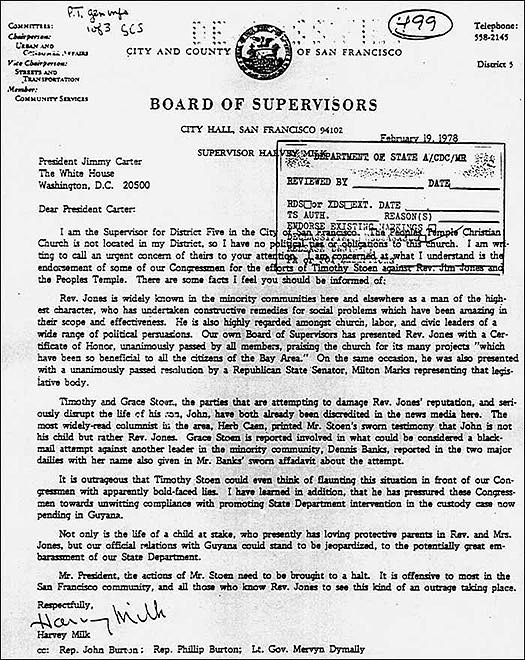
By virtue of producing rent-free rent-a-rallies for liberal politicians and causes, Jim Jones engendered enormous amounts of good will from Democratic politicians and activists. They allowed their political ambitions to derail their governing responsibilities. Frisco pols like Harvey Milk never seemed to care how Jones could, at the snap of his fingers, direct hundreds of people to stack a public meeting or volunteer for a campaign. City Councilman Milk just knew that he benefitted from that control, and therefore never bothered to do anything to inhibit the dangerous cult operating in his city. Instead, he actively aided and abetted a homicidal maniac. It wasn't just local hacks Jones commanded respect from. He held court with future First Lady Rosalyn Carter, vice presidential candidate Walter Mondale, and California Governor Jerry Brown.


Swingers +10 years
Chris Jones, writer extraordinaire, on Vince Vaughn and Jon Favreau:
"We're like the Sunshine Boys," Favreau says. "Did you ever see that? He's Walter Matthau."
Favreau looks at Vaughn. "Or maybe you're George Burns."
"Jon's my favorite writer," Vaughn says. "Even collaborating now with Couples Retreat, my job is just to help shape it. He's really the guy writing it."
"But Vince was smart enough to say, Hey, I'm at this point in my career, instead of just fielding gigs, let me generate my own material. It was about a year and a half ago, after the Spike Awards--"
"The Mantlers," Vaughn says.
"We won this award--"
"The Golden Mantlers."
"We were inducted into the Guys Hall of Fame. So we went to the Dresden of all places, where we hadn't been in years, and Vince laid out what he was going to do with Wild West and some of the ideas he wanted to pursue. He mentioned Couples Retreat. And I have a perspective on that, being married with three kids . . . "
"Are you done having kids?" Vaughn asks.
"Yeah, I'm done."
"You're not going to pull the goalie ever again?"
"No. Joy says, 'It's wife number two if you want more kids.' "
"Then you would have to move to, like, some Islamic country where you could have another wife," Vaughn says.
"Or nowhere. I could do the Hollywood thing, just hit reset."
"Or you could move into Warren Jeffs territory."
"I could set up a compound?"
"Yeah," Vaughn says, "a compound. That was so disturbing. You see all these little girls who look like extras from Little House on the Prairie. It's like Half Pint's been putting out for everybody. . . . "
"Polygamy seems appealing," Favreau says, "but then I've been watching that show Big Love, and you realize it's the same headaches."
"It's triple the headaches. Triple the nagging. Triple the question, What are you thinking?"
"Yeah, one marriage is enough," Favreau says.
"You have to pick out three sets of blinds."
"Anyway," Favreau says, "I'm in that place, coming from that perspective now. I couldn't write something like Swingers today, because I'm so far out of that."
"No, you have a good imagination," Vaughn says.
"No, Swingers, a lot of that stuff was stuff you'd said or stuff I'd heard about, and it gives you a personal take on the stuff. When I write, I need that."
"It blows my mind, seeing where Favs has gone with his career," Vaughn says. "I mean, Iron Man? Are you kidding? That's incredible to me, thinking about us not that long ago, sitting at the diner, trying to figure out how to get the money to make Swingers."
"Now that we both can make movies more easily," Favreau says, "the hard part is, What movies do I want to make? What means something to me? The challenges have changed. It's a lot different for us now. It's like being a short-order cook instead of being a chef, when you could pay such close attention to every part of the process. How do you bring that same quality when people are lined up around the block waiting for you to serve something up?"
Quotes of the day
I think Bernanke tends to treat [Ron] Paul's questions as if he were a first-year econ student, which is probably correct.--Eddy Elfenbein
Instead of creating a society that harnesses the powerful force of capitalism to benefit us all, which resulted in the development of light bulbs, automobiles and computers, we have created a system in which the spirit of innovation has been hijacked to find better ways to cheat society for personal gain. We have to face the reality that regulators alone can never keep ahead of the cheaters. An unfortunate aspect of human nature is that some people will always try (and succeed) at "gaming" the system, no matter how prescient and attentive our regulators.--Dylan Ratigan
At the end of 1998, GM's market capitalization was $46 billion and Ford's was $71 billion. Today both firms have negligible value, with share prices in the low single digits. Both are facing imminent bankruptcy and delisting from the major stock exchanges. Along with management, the companies' unions and even their regulators in Washington may have their own culpability, a topic that merits its own separate discussion. Yet one can only imagine how the $465 billion [in capital destroyed by F & GM] could have been used better -- for instance, GM and Ford could have closed their own facilities and acquired all of the shares of Honda, Toyota, Nissan and Volkswagen.--Daniel Yermack
The successful DC strategy before the successful surge strategy
recounted by William McGurn:
I don't think I am talking out of school to mention facts that have been recorded in newspaper articles and books as different as Bing West's "The Strongest Tribe" and Bob Woodward's "The War Within." The surge story begins back in 2006, when al Qaeda finally succeeded in setting the Shia and Sunni at each others' throats. That October, with Baghdad consumed by sectarian fires, Mr. Hadley tasked William Luti to come up with a new way forward.
Mr. Luti was then serving in the National Security Council (NSC) as special assistant for defense policy and strategy. A retired Navy captain who had commanded an amphibious ready group that included thousands of Marines, he was familiar with war planning. The briefing that he came up with was called "Changing the Dynamics: Surge and Fight, Create Breathing Space and Then Accelerate the Transition." You know it as "the surge."
The difficulty for these two men was that outside their colleagues in the NSC and West Wing, few wanted to hear about sending more American troops to Iraq. The Democrats wanted out and were declaring the war lost. Some Republicans were joining in. The Iraq Study Group offered a face-saving out, and many in the Defense and State departments wanted to take it. The American public was weary.
By having Mr. Luti draw up the concept for a surge, Mr. Hadley ensured that when options were presented to the president, one of them would be to fight. In Mr. Luti's strategic conception, securing the population became the top priority. In public, advocates like retired Army Gen. Jack Keane and military strategist Fred Kagan did yeoman's work to press the case for a surge. But within the White House decision-making process, it was almost this simple: No Steve Hadley, no surge -- and no success.
No Excuses Moment
for the liberal agenda, according to Bret Stephens:
This is a politics that has been in the making since at least 1968, though its real origins probably go back to 1944 and the first great liberal what-if: What if an ailing FDR had died nine months earlier, and been succeeded by the great progressive icon and polymath (and original moonbeam), then Vice President Henry Wallace?
In that case, perhaps, desegregation would have happened sooner, universal health care would be with us today, and the "century of fear" that Wallace predicted as the outcome of the Truman Doctrine would have been avoided by means of a more conciliatory policy toward the Soviet Union.
From that moment on, the liberal what-ifs multiply in dizzying profusion. What if John F. Kennedy had dodged the bullet in Dallas and lived to get the U.S. out of Vietnam before it fully got into it? What if Robert F. Kennedy had dodged the bullet in L.A. five years later? What if Jimmy Carter hadn't been so earnest, truthful and unlucky? What if Ronald Reagan hadn't proved such an adept political mythmaker? What if Donna Rice hadn't been pictured on Gary Hart's lap? What if Willie Horton hadn't been given a furlough? What if Bill Clinton hadn't squandered his political gifts with cheap trysts? What if Bush v. Gore had gone 5-4 the other way? What if 9/11 hadn't intervened to give the Bush administration its mandate for another bout of the politics of fear? What if John Kerry hadn't been sandbagged by Osama bin Laden's last-minute video intervention?
...The upshot of all this has been an amazing lack of introspection among the frequently wronged, but never wrong, liberal American hard core. Politically, this hasn't yielded such great results: The number of Americans who self-identify as liberals continues to fall, to 21% in 2008 from 22% in 2004, according to CNN. (The number of self-identified conservatives held steady at 34%.) Then again, without that hard core Mr. Obama's primary triumphs would never have been possible.
Now the long wait is over, and the liberal ship has come in. In Mr. Obama, liberals have a president who seems to have stepped out of the last episodes of the West Wing. He has the Congress in his left pocket, the news media in his right pocket (or is it the other way around?), and he floats on a tide of unprecedented international enthusiasm. The Republican Party has no obvious standard-bearer, as it did in Ronald Reagan after Gerald Ford's defeat in 1976. It could well spend the next four years, or eight, tearing itself to pieces.
Instead, the only things that stand in Mr. Obama's path are what Marxists like to call "objective factors": the financial crisis, the mess in Detroit, the disposing of Guantanamo detainees, the wars in Iraq and Afghanistan, Russian hostility, Chinese assertiveness, maybe the disintegration of Pakistan.
Why government is infrequently the solution

and often the problem:
City and state politicians want voters to believe that they have been careful stewards of taxpayer money, searching out waste far and wide, and genuinely doing everything they can to control government bloat. Ah, no.New York City did witness a reduction in public employment in 2002 and 2003, during the last period of slower economic growth. But the city quickly resumed its habit of ever-growing payrolls, and they have kept growing rapidly in the years since -- to an estimated record this June 30 of 313,965 employees on the public dime, according to the Mayor's office. That's an increase of more than 40,000 public workers in a year when Wall Street has been enduring historic losses and laying off tens of thousands of people.
Monday, November 17, 2008
Global warming scientists
are losing credibility (via Tom Smith):
If there is one scientist more responsible than any other for the alarm over global warming it is Dr Hansen, who set the whole scare in train back in 1988 with his testimony to a US Senate committee chaired by Al Gore. Again and again, Dr Hansen has been to the fore in making extreme claims over the dangers of climate change. (He was recently in the news here for supporting the Greenpeace activists acquitted of criminally damaging a coal-fired power station in Kent, on the grounds that the harm done to the planet by a new power station would far outweigh any damage they had done themselves.)
Yet last week's latest episode is far from the first time Dr Hansen's methodology has been called in question. In 2007 he was forced by Mr Watts and Mr McIntyre to revise his published figures for US surface temperatures, to show that the hottest decade of the 20th century was not the 1990s, as he had claimed, but the 1930s.
Another of his close allies is Dr Rajendra Pachauri, chairman of the IPCC, who recently startled a university audience in Australia by claiming that global temperatures have recently been rising "very much faster" than ever, in front of a graph showing them rising sharply in the past decade. In fact, as many of his audience were aware, they have not been rising in recent years and since 2007 have dropped.
Dr Pachauri, a former railway engineer with no qualifications in climate science, may believe what Dr Hansen tells him. But whether, on the basis of such evidence, it is wise for the world's governments to embark on some of the most costly economic measures ever proposed, to remedy a problem which may actually not exist, is a question which should give us all pause for thought.
Subscribe to:
Posts (Atom)